Tuesday, April 29, 2014

"Doomsday +1" - '70's post apocalyptic goodness from Charlton Comics

"Doomsday +1" was a post apocalyptic science fiction comic series published by the small, Derby, Connecticut-based publisher Charlton Comics.  The series ran for twelve issues with the first six issues running from July 1975 to May 1976 while the second six issues were simply reprints of the first six issues labeled 7 to 12. The reprints ran from June 1978 to May 1979.


The cover of issue one is wrong ... the astronauts did not arrive back in
New York and this art was clearly a homage / play to the
highly successful "Planet of the Apes" franchise.

"Doomsday +1" is probably best known as the first original, color-comics series by artist John Byrne who would eventually become a major industry figure.  The series was created by writer Joe Gill with John Byrne doing the penciling and inking while George Wildman served as the editor. 

Byrne, serving as letterer, used the pseudonym "Byrne Robotics" while working on issues #4-6 (later reprinted as issues #10-12). The credits for issue #5 show the artwork as "Art: Byrne Robotics with technical assistance from Patterson-75", a pseudonym then for Bruce Patterson who provided some degree of inking.  Byrne drew the covers of issues #2-6, with the cover of issue #1 variously credited to Byrne and to Tom Sutton. Issues #7 and #11 featured re-colored reprints of Byrne covers, while issues #8-10 and #12 featured "new" covers created by blowing up panels of interior artwork from the stories.


The stories ran from 22 to 23 pages with most issues also containing a two-page text backup — either a story featuring the main characters or a non-fiction featurette. The backup story in issue #5 consisted of two comic pages, drawn by Steve Ditko, of "real world" paranormal vignettes.  These stories were, by and large, nothing more than filler.


Synopsis:  "Doomsday +1" features some of my favorite genres; atomic holocaust, survival, astronauts returning to a devastated Earth and a good dose of science fiction / science fantasy thrown in.  "Doomsday +1" occurs in the near future (then the late '70's / early '80's) in which a South American despot named Rykos, facing a military coup de tat, launches his sole two atomic missiles on the world.  The atomic missiles are targeted on New York City in the United States and Moscow in the U.S.S.R. Both cities are destroyed.  The two superpowers, each believing the other has launched a first strike, launch their own atomic arsenals at each other in retaliation. The truth becomes known and American president Cole along with Russian premier Mikhail realize their errors but it is too late; the fully automated nuclear-missile systems of each country can not be countermanded or turned off.

The world is doomed to atomic holocaust.


Only hours before the apocalypse begins, a Saturn VI rocket bearing three astronauts launches from Cape Kennedy in Florida.  Onboard the Apollo style command module are three astronauts: Captain Boyd Ellis, United States Air Force; his fiancĂ©e, Jill Malden; and Japanese physicist Ikei Yashida.  All three astronauts witness the atomic holocaust from the safety of orbit.  Weeks later, after the post-apocalyptic radiation has subsided to safe levels, their space capsule lands upon a melting Greenland ice field.  Seeking shelter, the three astronauts make it across the ice field and encounter a wooly mammoth, frozen alive for thousands of years and now thawed due to the atomic exchange.  They are saved by an equally ancient Goth named "Kuno" who joins the party but is the man lost in time among all the high technology that the astronauts depend on to survive.

Crossing over into Canada using a sail boat / yacht, they are attacked by a robot operated fighter jet.  Arriving at a Royal Canadian Air Force base, they make the base their home only to discover that a crazed Russian scientist / cyborg has them in his sights.  The Russian cyborg sends hundreds of robot paratrooper infantry to attack the RCAF base and the astronauts.  


Boyd Ellis uses a RCAF jet fighter to strafe the robots from the air while Jill, Ikei and Kuno make ground attacks using laser rifles (backpack mounted power packs) and an atomic powered tank (with a flamethrower cannon).  Boyd Ellis must land his jet when he is low on supplies and he is captured by the robots and taken to Russia to be interrogated by the Russian Cyborg.  Jill, Ikei and Kuno all board a RCAF supersonic transport, travel to Russia and with the help of Boyd, defeat the crazed cyborg and escape back to Canada.  The cyborg threatens revenge but Boyd tells him that if he tries anything that Boyd and the others will return and nuke the cyborg thus offering mutual assured destruction.

Back at the base, Boyd and Jill realize that they have grown apart and may not be the couple that they once planned to be.  Jill seems taken with Kuno now and Ikei, long jealous of Jill, is ready to move in on the vacant spot that she is leaving in Boyd's life.

The first two books in the series (detailed above) are probably the best in the way of story telling.  Later issues tended to get a little bit silly.  Plots included meeting robot guardians from a highly advanced galactic civilization who are here to pass judgment on humans for their folly (and let the astronauts teach them the error of their ways).  The astronauts deal with an underwater city being attacked by ancient aquatic enemies, visitors from a future utopia and of course, a group of other American survivors who want to do away with Boyd and Kuno and keep the women for their own needs and pleasures.

Overall, "Doomsday +1" pleases on a base level that, as a child, I found hard to ignore.  This series pandered to all of my post apocalyptic day dreams and my original copies of this short-lived series are very dog eared, especially issue #2 with the epic air and land fight against the Russian robot death machines.  The art is okay (Charlton was never known for its fantastic art quality) but the story, at least the first two or three issues) goes far in supporting what the art can't convey.

And it's John Byrne whose art is iconic and it's early John Byrne so that counts for something as well.

Tuesday, April 22, 2014

Ricardo Delgado's "Hieroglyph"


Digging through the piles of crap that I need to sort in my study I came across a four part sci-fi comic series that I had almost forgotten about.

I like comics.

As a child I used to read comic books a lot but the older I got the less I read and the less I collected them.  Super heroes don't do anything for me, never really did so while I enjoy the occasional "Batman", "Spiderman", "Iron Man" and "Avengers" movie you won't find any of those comics in my meager collection.  No, I grew up reading stuff like "The Losers", "Sgt. Rock", "The Unknown Soldier", "Weird War Tales", "Tales of the Haunted Tank", etc.  Later, in my late teens and early twenties my taste in comics both waned and got pretty picky to the point that I might get a few comics a year and those comics would have to be pretty frigging outstanding.  They were almost invariably science fiction ...  This curve of decline of interest in collecting comics / required quality of comic to be collected only grew as I got older.

Flash forward to 2000.

I'm in a comic / hobby shop and I see the first issue of Ricardo Delgado's "Hieroglyph".  I can't say that the cover is the greatest in the world but being a fan of all things weird and Cthulhu-ian I was intrigued so I picked it off the rack and gave it a readsy.  I was impressed with Delgado's artwork.  The story followed an astronaut from Earth on some vague mission to explore the universe.  He's separated from his family by time and space.  He has a giant "mothership" in orbit and he takes a shuttle down to the latest planet he's supposed to investigate / catalog.  

The shuttle is the size of a B2 stealth bomber (and looks amazingly like a B2 stealth bomber).  Landing on the planet he muses that he's going to be bored, he'll get this planet cataloged quick and then be on his way to yet another boring world in a long line of boring worlds until his mission is up and he can get back to his wife and two kids.  Shortly after that, everything changes and the astronaut discovers that not only is the planet not dead but that it has untold amounts of different lifeforms in types that defy the imagination.  The astronaut also quickly becomes part of a holy war fought over a pentagon shaped talisman with unknown powers but powers that every faction on the planet is willing to go to extremes to possess.


The premise is simple and a bit loose but the artwork is delightful.  Taken from Delgado's fascination with the wonders of ancient Egypt, the art of "Hieroglyph" focuses on the grand and the immense.  Going into space, let alone flight to other stars is not a small feat of technology yet despite all the amazing advances of science and engineering that Delgado has given to the Astronaut ... all of that seems dwarfed, literally, by the immensity of the ruins that the Astronaut continually comes across.  Ancient alien temples, burial chambers of long dead alien rulers, weird alien hieroglyphs, fossilized bones stuck in strata of rocks ... it blows not only the Astronaut's mind but the reader's mind as well.


While the artwork is not as tight or sharp edged as Frank Miller and Geoff Darrow's "Hardboiled" but similar in nature in that the visuals tell the story and the text is really only there to join certain ideas together and sometimes to speed things along when the visuals bog.  It's not the "Blade Runner" meets "Where's Waldo" of "Hardboiled", more like an epic tour of an amazing alien panorama where the details are not tiny but rather vast and sweeping visuals.

Trust me, it works and Delgado's artwork would have been right at home in the late 1970's sharing pages of "Heavy Metal" magazine with the likes of Moebius, Moreno and even Corben.


"Hieroglyph" has plenty of artwork and eye candy.  It lacks a whiney protagonist which endears it to me because I myself am a strong individual who deplores whiney or useless people.  I find it hard to believe that someone can go through something as hard as astronaut training only to wind up some blubbering, inwards collapsing wimp at the first sign of trouble.  Such is not the hero astronaut of Delgado's "Hieroglyph".  No, the astronaut faces his fate / destiny with little or no whining, not the usual liberal limp wristed, hand wringing, soul searching, self-defeating, self-loathing pseudo heroes that the insipid pop culture of our once great society has forced upon us lately.  Even for a nearly 15 year old comic series, it's refreshing to see the main character show some stoic traits, accept his fate and deal with it.


If any story cries out to be released as a complete trade paperback it is "Hieroglyph."  I have read where finding this series is kind of difficult.  I can't tell you because I collected it month by month when it was first published.  

Delgado has a blog if you wish to know more about him.  Find it here.

Final verdict?  If you're picky like me about comics and you like great art and lost astronauts then "Hieroglyph" is probably worth checking out and collecting.  Perhaps Delgado will do a sequel but with a decade and a half so far those hopes grow dimmer and dimmer.

Wednesday, January 01, 2014

TSR's "GAMMA WORLD" - Post Apocalypse Role Playing Game


Growing up in the 1970's was an interesting time ... it was fun mixed with gloom.  The ever present spectre of America and Russia nuking each other back into the Stone Age was a fear that was driven home constantly.  Disaster movies, end of the world movies and a host of other media came at us like a tidal wave but instead of scaring me half to death it only fascinated me.  As I grew up, the post apocalypse scenario became the stuff of day dreams for me, not nightmares.  Somewhere during that time I started to become a loner ... movies like Charlton Heston's "The Omega Man" weren't scary to me ... they were a dream come true if they had been reality and I'd been "The Omega Man."

My early desire for science fiction began with the much celebrated "Planet of the Apes" franchise ... I was a kid and lived through seeing all of the movies on TV, followed by watching the TV series and the animated series.  That was the first of my taste of post apocalypse sci-fi and I craved more.  The more I got a taste of it, the more post apocalyptic science fiction really took hold of my imagination.  Books like "Damnation Alley", "War of the Worlds" and "The Time Machine" only fueled my love of a devastated future and the brave struggles that would be needed to overcome the folly of man.

It was late 1977 when science fiction really just came out of nowhere and seized my imagination.  I was 8 years old, "Star Wars" didn't make it to Hattiesburg, MS until the Fall of 1977 but I finally got to see, on the big screen, what everyone else was raving about.  After months of being teased by pictures and articles in magazines and the occasional rare commercial for that movie, "Star Wars" finally arrived like a tidal wave and it lit a fire in my brain, an out of control science fiction fire that continues to burn hot and bright even today.  

Science fiction had me by the soul and I was hooked and one of the greatest outlets for my imagination in my single digit years was science fiction role playing games and out of those sci-fi role playing games I think that TSR was the main provider of my entertainment for the most years.  From third grade to ninth grade, 1977 to 1983, I was a devout game player.

My first introduction to role playing games was TSR's classic "Dungeons and Dragons", the basic edition boxed set which my best friend bought and we played in the Fall of 1977, probably around the time that "Star Wars" hit the silver screen locally.


This was the first time that I'd ever played a role playing game before and even though my interest was piqued in role playing games that same interest let me know real quick that fantasy (i.e. elves, dwarves, dragons, magic, etc.) just wasn't where my heart lay.  

Everyone back then was playing D&D, from elementary kids to college students but my heart just wasn't into fantasy or sorcery.  A lot of people my age were big into Tolkien but the closest I ever got to Tolkien was the Rankin / Bass animated musical "The Hobbit" and even that couldn't turn my interest in fantasy.  Even Ralph Bakshi's animated "The Lord of the Rings" didn't grab me so while other kids were trying to come to grips with Tolkien's works, the "D&D" craze and then "Star Wars" I was lucky in one respect ... my heart was set on science fiction.

Of this I was sure.

Science fiction.

Just science fiction and TSR answered the desire for both science fiction and role playing with their 1978 post apocalyptic opus ... "Gamma World".


I first saw "Gamma World" advertised in "Boy's Life" magazine, yes, the Boy Scout magazine but then like I said, role playing games, especially "D&D" were really gaining in popularity during this time.  I mean, when Sears put a "D&D" boxed set in their Wishbook catalog and when "Gamma World" (with the illustration shown above) appears on "Boy's Life" then you were dealing with a game, nay, a phenomenon that would make history in its wake.

"Gamma World."

Science fiction role playing set in a post apocalyptic far future.


Robots and mutated animals and Mark V blasters!  Oh my!

"Gamma World" was the product of James M. Ward and Gary Jaquet and was a boxed set, like the "D&D" basic set.  I bought my first edition "Gamma World" boxed set at "Bookland" in the Cloverleaf Mall.  It cost me $10, was shrink wrapped, and displayed proudly in a cardboard display stand near the front of the store.  I rode my 10 speed bike home from the Mall with my pocket ten dollars lighter and the "Gamma World" boxed set in my backpack.

For your money you got a nicely illustrated cardboard box (bookshelf type edition) with a colored front and a black and white back.  Early editions had no rear illustration or description of the game / box contents so a simple sheet was put with the box and then shrink wrapped to the outside / back box bottom.


Inside the box was a nicely illustated black and white (two color) 57 page rulebook ...


 A map of the devastated North American continent ...


I never drew on my map ... I guess I didn't want to ruin it.  Instead, I would put hex paper over an area, trace the outline of any major areas and then fill in the hex paper with the details.  I also guess that is why my original first edition GW map is still pristine even today.

The boxed set came with dice like I'd never seen before.  Mind you, like I said before, my "games" were limited to the offerings from the likes of Milton Bradley and Parker Brothers.  These new games, where you had to use your imagination and you had to make your own maps (game boards) and there were dice in the shape of stuff you learned in math class ... all of this was new and cool and awesome!

"Gamma World" came with six polyhedron dice; a four sided die (d4), a six sided die (d6), an eight sided die (d8), a ten sided die (d10), a twelve sided die (d12) and a twenty sided die (d20).  The dice were different than any dice I'd ever owned as a kid before.

The dice were molded in white plastic, at least the dice that came with my game were.

The game also came with an unbranded, paper wrapped white crayon.  I had no idea what the crayon was for ...  A friend once told me the crayon was for marking on the map but that didn't make sense.  Another friend said it was for coloring in the numbers on the dice so they would be easier to read ... that didn't make much sense either since it was a white crayon and the dice were white.  To this day I still don't know what the damn white crayon was for ...  I just took a Pilot Razorpoint ink pen and used that to fill in the numbers on the dice.  That lasted for a few weeks of constant play and then you had to highlight the numbers again.


Gameplay for GW was heavily based off of the "D&D" game mechanics with stuff like hit points, six attributes ranging from 3 to 18, saving throws, armor class and hit dice.  Combat took the weapon class of whatever you were using, cross referenced that to the armor class of your target and gave you a number to roll equal to or higher in order to succeed in combat.  I liked this because it made it hard for someone with a wooden spear to hurt someone in power armor, all of which just made sense.

"Gamma World" took place on Earth.  A century after a final, cataclysmic global war almost wiped all of life on Earth out the survivors, mutants, humans, animals and plants, all vie for dominion.  Knocked literally almost back to the Stone Age, rites of passage for tribals include journeys or pilgrimages to the ancient ruins where the tribals would face all sorts of dangers ... malfunctioning robots, complex security systems, killer plants, mutants, mutated animals, and even radiation.  If you made it back alive with an artifact or some other proof that you'd been to the ruins ... if ... then you became a member of the tribe.

If you were lucky enough to find an artifact then you had to spend time to figure out how to use that artifact.  Artifacts came in three levels of complexity ... something like a grenade was simple, figuring out how a control panel in an automated factory that built robots was very complex.  Sometimes you figured it out, sometimes you broke it trying to figure it out and sometimes you hurt or killed yourself (or someone else) trying to figure it out.  Figuring an artifact out required time spent and die rolls to be made.  The charts shown below became a familar page to reference to in the rule book.


"Gamma World" grabbed my imagination ... if I was going to role play some character in a primative background that would be swinging a sword and fighting for their life then I'd rather be doing it in a sci-fi post apocalypse seting than in some dungeon.  I preferred mental mutations to magic, any day and robots and carniverous plants to elves and dwarves.


Our GW games were drawn out on sheets of notebook paper clipped into Mead 3 ring binders, our campaigns were sketched out in spiral bound notebooks and our maps were sketched out on sheets of graph paper and hex paper.  Several of our characters were long term characters used over a period of years ... one was a Sleeth that had a sawed off double barrel shotgun.  This character was active so long that when Lou Zochi introduced his 30 sided die that the Sleeth character got to use that to roll to-hit instead of a 20 sided die.  The double barrel sawed off shotgun, as I care to remember, was a favorite weapon of our impressionable youth no doubt brought on by our recent viewing of Mel Gibson's titular character in the movie "Mad Max."

Other fond memories I have of this game include finding a Pure Strain Human in suspended animation in a fallout shelter and reviving them.  That PSH helped our characters understand all the technology that we'd later find.  We also found a non-functioning android in the same shelter and the PSH programmed it to aid us as well ... kind of like "The Questor Tapes".

The first edition of "Gamma World" was the best ... each subsequent edition not only added more useless and needless things to the original edition but each new addition also watered down the vast, rich story included in the original edition and even sometimes made a parody of it.  Over the years less attention of the game was paid to the struggle and more emphasis was spent on who could design the whackiest mutant creature of all.  GW went from being something that was interesting and fun to being something that was a caricature of itself.  The first edition GW game had the richest history, the best equipment, the best monsters, mutations, and robots.  Other editions gutted the rich context of the first generation, all trying to outdo it ... and none succeeded.  

None.  

I own just about every edition of GW that's been made but it's still the first edition that I hold in high regard, the later editions not so much if at all.

So many hours of my youth were spent thumbing through the GW rule book, inventing new artifacts and weapons, drawing out characters and equipment.   I haven't played GW in a long, long time.  The last time I played GW was probably 8th grade, make it 1983 or so.  I miss it in the way that you miss things that have passed into memory and GW still holds a special place in my study, the original boxed set that I bought all those many years ago sits on the shelf next to my "D&D" basic set.

I guess, in a way, my boxed sets of old TSR RPGs have become artifacts in and of their selves.  Ironic ... but maybe fitting as well.

Tuesday, December 31, 2013

TSR's "Attack Force" Minigame

I've recently covered TSR's Minigame "Revolt on Antares", one of TSR's chances at dipping into the microgame / pocket game market first realized by Austin, TX based company "Metagaming".  I'll make a personal confession here ... for me, games in my life, in my wee years (1969 to 1977) consisted of card games like "Go Fish" and "War" as well as stuff like Milton Bradley's offerings.  Most of my "games" were the mass market, childhood staples ... fun kids stuff like Parker Brothers "The Six Million Dollar Man".
 

Finding "OGRE", my first Microgame from Metagaming in 1977 not only turned my world upside down (gaming wise) but it blew my mind.  This is easy to do for a 7 year old avid sci-fi quasi nerd ... here was a game that picqued my imagination and it fit in my pocket (or my 3 ring binder when I snuck it to school).  Small format, with only a few illustrations and a dump truck load of imagination.

For years Metagaming had the monopoly on "microgames" but the blood was in the water and other big fish began circling the cloudy waters ... big fish like SPI and TSR.  TSR's entries were limited but bore TSR's high quality (at least to me).  Sometimes manufacturers have a "tell", a certain "feel" to their games and TSR's minigames generally had that TSR "feel" to them.  As a kid I was drawn to this "feel", at least for two of TSR's offerings; "Revolt on Antares" and ... "Attack Force".


Designed by David James Ritchie, the main two things that can be said about TSR's 1982 offering "Attack Force" is that not only is it part of a family of "copy-cat" games that tried to cash in on the amazing runaway financial success of "Star Wars" but it is amazing to me why George Lucas didn't sue the ever living hell out of TSR for this game.  

In the time following the release of "Star Wars" on the silver screen, George Lucas was a sue happy zealot, going after the likes of Ideal for their "Star Force" line of action figures (which predated "Star Wars" and bore a remarkable resemblence to C3PO and R2D2 long before there actually was a C3PO or R2D2) and going after "Battlestar Galactica" because, you know, if you were to watch "Star Wars" and watch "Battlestar Galactica" the similarities really just jump out at you ... not.

"Attack Force" is, in a few short words, the final epic starfighter battle of 1977's super sucessful "Star Wars" played out on paper with die cut counters and a pair of six sided dice to determine the outcome.  If you have any doubt to that, the catch phrase on the front of the game, "Starfighters stalk planet killer" should remove all doubt but if there are any further doubts, let me try to remove that as well.  Just read the back of the instruction manual ...


Game play revolves around four flights of star fighters, divided into two types; Falcon and Eagle (which could be X-wing and Y-wing).  Four flights of Arcturan starfighters, four different colors of flights, facing a round, planet killing Nova Ship which not only has surface mounted launch bays for Imperial fighters but also a vast network of surface mounted defence turrets.  The defense turrets, which consist of lasers, blasters and pom-poms, can move along a track type of network giving the Nova Ship not only a variable defense but one that can be modified or arranged according to the desires of the Nova Ship player.  Each type of surface battery has a different type (or volume) of firepower giving each a unique strategy in setting up the defense as well as playing the game.


Imperial fighters come in two varieties; standard and custom.  The standard Imperial fighters are called "Cobras" while the custom fighter is a super fighter owned by the Imperial hero Vaj Korsen, evil tyrant of the Empire of the First Born.  The similarities between the Nova Ship and the Death Star, as well as Vaj Korsen and Darth Vader, right down to each having their own "next gen" starfighter.

Even as a 12 year old kid, the name "Vaj" caused more than a few pre-pubescent giggles and laughs at our games.

As for the weak point, the Achille's Heel of the Nova Ship, there are several exhaust ports which the Arcturan starfighters must attack in order to destroy the Nova Ship.  Only an attack against the correct exhaust port will set up a chain reaction that will destroy the Death Star ... sorry, the Nova Ship.  The actual exhaust port is randomly placed each game making each game different from that point of view.  I wonder if the exhaust port was only two meters wide ... the only thing missing from this game was a trench run.

Playing this game was a lot of fun back then.  The game itself was simple and didn't take a lot of time to set up or play (one of the great things about the small format games) but the real attractiveness of the game was the counters ... 

The counters for the Imperial Cobra starfighters, the Arcturan Eagle and Falcon starfighters were easy to use with TSR's other (then) contemporary science fiction offering "Star Frontiers" and its spaceship supplement "Knight Hawks".

Like I said, it amazes me that George Lucas never sued the hell out of TSR for such a blatant "Star Wars" ripoff as this game was.  Once an inexpensive offering from TSR, "Attack Force" is the second and last minigame offering from TSR that I bought and it still remains a guilty pleasure to play every few years.

Sunday, December 29, 2013

"The Last American" - Post Apocalyptic goodness from Marvel Comics


"Are you there, God? Come on out! I got a bone to pick with you! A bone -- hah! That's a good one! I got a million bones to pick with you, pal! All the bones in the world! This is all your fault! That's right! You coulda stopped it -- why didn't you? Eh? You're so all-damn powerful, why didn't you do something? Have you seen what it's like out there? Have you? Well, I'll tell you, pal! If there is a God then you gotta be one twisted, evil son of a bitch! Damn you! Come on! I'm not afraid of you! Strike me down! Gimme the big zap! What are you waiting for? Had enough death? Sickened even yourself? Don't worry! You'll be doing me a favor! I don't any part of this. I don't want to be the last American..."  -- Ulysses S. Pilgrim

  
"The Last American" (hereby abbreviated TLA for brevity’s sake) was a four issue comic written by John Wagner and Alan Grant with two issues being done by each author supposedly at the end of their professional relationship (a relationship that was rapidly sinking against the jagged rocks of artistic differences).   

Mike McMahon was the artist for all four issues.  

 Published by Epic Comics from December of 1990 to March of 1991, TLA was a four issue limited run that left off with a slightly open-ending.  I became interested in this particular work for the primary reason that it fulfilled two of my strongest fascinations … waking up from long term suspended animation in a strange, new world (ala Rip Van Winkle) and the post apocalypse.  I've always been fascinated with stories about ordinary people thrust into environments beyond their control and often times beyond their understanding.


The story of TLA centers on Ulysses S. Pilgrim, a disgraced US Army soldier in military prison for some unknown but obviously severe crime.  Pilgrim is chosen to be the last American, a project which will put him in suspended animation for 20 years deep inside a hardened bunker in order to (hopefully) survive World War III.  At the time of Pilgrim being chosen for the project, for whatever reasons, global nuclear war is imminent and unavoidable and time is running out.  Pilgrim is whisked away from his family, put into the bunker with enough supplies to weather the coming war, and given the task of waking up in 20 years to begin the rebuilding the United States of America.

The story begins on July 4, 2019, at twelve noon, twenty years after the nuclear war.   Pilgrim wakes up in a bunker, attended to by a likable robot valet / Man-Friday named “Charlie” who is obsessed with pop culture (the robot has had twenty years to absorb all the substantial archive of recorded pop media that the bunker has to offer) as well as two large, gruff, all business-like, no-nonsense combat robots named “Able” and “Baker” (A, B, and C for you non-military types).  Charlie serves as Pilgrim’s personal valet and as a go-between for Pilgrim and the two combat robots.

Pilgrim’s first questions when he wakes up is “Who won?”  Before he can receive an answer from Charlie he admonishes himself that what he just asked was a pretty stupid question, in hind sight.

Waking up and leaving the bunker, Pilgrim and his three robot companions travel the devastated America in a large, squat, armored ATV.  They find nothing but destruction and desolation.  Along the way, Pilgrim has flashbacks and memories of his life before he went into suspended animation.  We learn of the life he left behind, his wife, his young son.  He pines for them during his travels, even almost visiting the place where he and his wife first met by accident (he ran over her bicycle with his VW bug).  Along the way, the destruction and devastation are so great that Pilgrim has trouble dealing with the immensity of the fate of the human race.   

When offered a bottle of whiskey he proceeds to get drunk and curse God.  His fourth travelling companion, a hallucination, a figment of his imagination, is Bert the Turtle from the old Civil Defense films of the 1950’s.  Bert becomes his best friend and talks to him all the time, often serving as a filter to help Pilgrim understand the situation that he is in and the situations that he finds himself in.  This seems to upset the two combat robots and concerns Charlie who sees Pilgrim’s continual backwards mental slide as some kind of failure on Charlie’s part to take care of Pilgrim during his 20 year long hibernation.


Able: "It ain't my job to be worried about his state of health but if it was my job to be worried I'd BE worried."

Charlie: "Oh, Doctor Kildare!  You're so handsome when you diagnose!"

Able:  "Come to that.  I'd be worried about YOUR state of health."

With only four issues to tell a story I won’t ruin it by giving a complete summary of the story, suffice to say that if you like post-apocalyptic stories then TLA is a little bundle of pure PA candy.

TLA is a great post-apocalyptic treasure and at just four issues it doesn’t take a deep wallet to add it to your collection or a lot of time to add it to your memories.  The designs of the robots and the ATV are solid if a bit whimsical but Pilgrim’s uniform looks more for show than actual use.  He is a caricature of America, even more so than Uncle Sam ever was.

All in all, TLA is solid and is one of those lost gems that would make a great movie, even if it only made it as a low budget, CGI heavy movie in the same league as most Sci-Fi channel movies.  Hell, you could make this movie with only a handful of people and I'd suggest the more less well-known the better.  The robots would be simple to build or even easier to just CGI together, ditto for the ATV and the PA backdrops.

Saturday, December 28, 2013

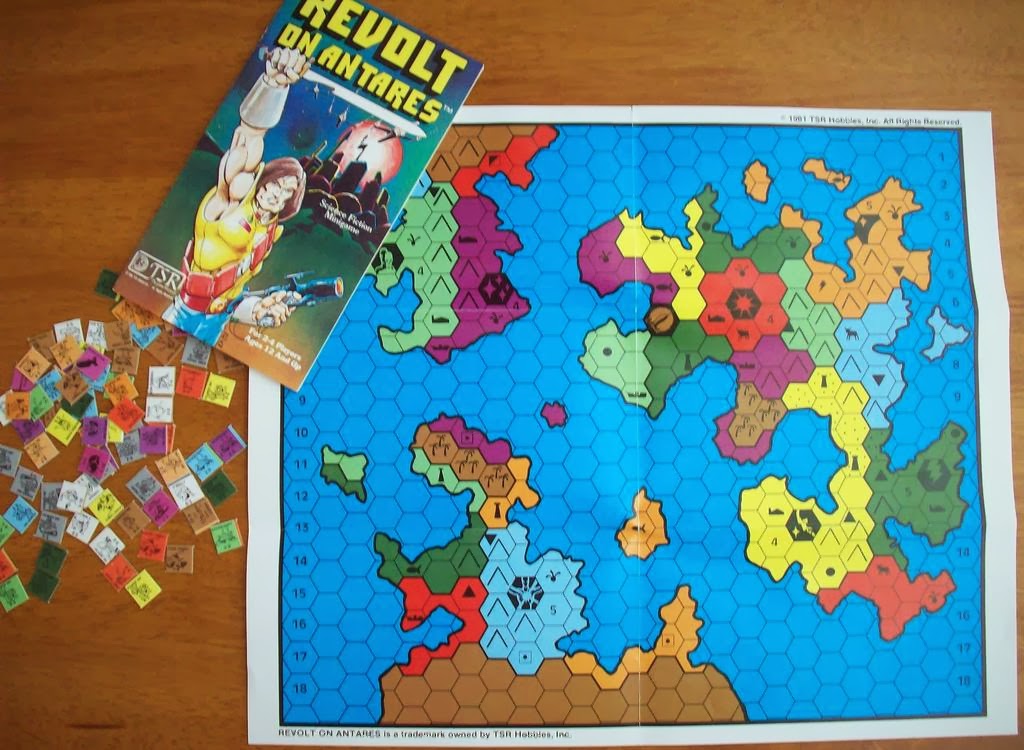
TSR Minigame – “Revolt on Antares”


Being a particularly smart but wholly unchallenged kid growing up left me to fill in the gaps and one of those gaps that entertained my spinning mind was wargaming.  There came a golden age of gaming and that age was the late 1970’s and the early 1980’s. Bookshelf games like Avalon Hill’s “Tactics II” and SPI’s “Invasion America” were the large format games, full of heavy stock folding maps, exhaustively numbered yet scantily illustrated rules and a metric ton of die-cut counters.  Those games dominated the early to mid 1970’s but gave way to the likes of TSR's role playing games in the late '70's and early '80's.  Mid-level games were the boxed sets, with individual scenarios or game modules, richly illustrated and making use of multiple polyhedron dice.  The mid-level games mostly belonged to the RPG role playing games genre like TSR’s “Dungeons and Dragons” and other such ilk.  Below that were the small scale format games made extremely popular in the late 1970’s with Austin, TX's own Metagaming’s line of “Microgames”.


Microgames were big sellers … at $2.95 each, a microgame came with an attractively illustrated and compact rule book about the size of a quick reference guide, a fold out map limited to a handful of colors (at best) and a single sheet of counters that you had to cut out yourself (the more fancy games had die-cut counters that you just punched out from the “sprue”).  These games often used a six sided die to determine game results though very few of these games actually included the dice and if they did they were incredibly small, the size that you could fit on a fingernail with plenty of space to spare.  All of this tiny gaming goodness came to you in either a simple plastic closure bag or a “Ziploc” type bag.  Later offerings from Steve Jackson Games actually came in plastic clamshell boxes but no Metagaming offerings were ever offered in these types of cases.

Some of the more successful small format games were, of course, “OGRE”, “GEV”, “Car Wars” and the various “Car Wars” supplements like “Sunday Drivers” and “Truck Stop”.  Metagaming made a name for itself and the “microgame” early on so it was no wonder that a gaming giant like TSR would see the microgame format (and market) as something that they could enter and hopefully make a profit in.  One of the first TSR offerings in the newly cointed “minigame” market (because “microgame” was, I think, was an actual copyrighted term) was “Revolt on Antares” hereafter referred to, for brevity’s sake, simply as “ROA.”

 
“ROA” remains one of my favorite small format game offerings from that time.

I picked up my copy of “ROA” in Bookland at Cloverleaf Mall back in 1981 late one Friday afternoon after school.  It was a quick purchase, I knew exactly what I wanted and exactly where it was, about a third of the way inside the store in its own special standup cardboard TSR display rack.  I was headed on a Boy Scout hike to one of the military parks, Vicksburg or Shiloh, I can’t remember.  It was going to be cold, wet and an overnight trip.  Being in the Boy Scouts, we played a lot of D&D and Gamma World … two favorites which usually were taken on overnight trips or week long camping trips to Camp Tiak.  Microgames were another popular thing to pack among the wargaming scouts and stuff like “Melee”, “Wizard”, “OGRE” and “GEV” were often played late at night in the hallways of the National Guard armories where we spent the night in our sleeping bags.  Flashlights, notebooks and the sounds of pencils on paper and dice rolling were common for hours, accompanied by the low playing cassette tapes of Rush “Tom Sawyer”, the Gap Band’s “You dropped a bomb on me”, and AC-DC’s “Dirty deeds done dirt cheap” on our “boom boxes”, all before lights out was called by the Scoutmaster.

This particular trip, be it Vicksburg or Shiloh, I picked up TSR’s “ROA”.  It cost me $9.99 (which was three times what an average “Microgame” cost then) but it was worth it.  “ROA” was, perhaps, the greatest and best of the TSR small format offerings.  It came in a blisterpack that was unfortunately disposable and included a richly illustrated rule book, two standard sized six sided dice, a die-cut counter sheet and a lavishly colored map (so different than the simple two and three color Metagaming offerings at the time).  The counters were richly illustrated as well, very detailed as opposed to the typical symbols of infantry and armor given in the more traditional wargames.


“ROA” told the story of political intrigue and war on the planet Imirrhos, ninth planet in the Antares star system so technically the game should have been called “Revolt on Imirrhos” rather than “Revolt on Antares” since no revolt was actually occurring on the surface of the star.  Imirrhos was a planet divided between seven powerful houses or kingdoms, each house had its own individual leader each with a special power and their own army.  Whether the powers that each leader had were some kind of mutant power or due to some kind of technology advantage it wasn’t really clear though some of the powers did seem to be more mutations (long range telepathy) than anything that could be explained away with science (like the ability to teleport units or cast unpredictable lightning).  


And, speaking of science … each house had in their possession a single ancient artifact, a bit of super advanced, barely (if at all) understood science from a long dead race that had inhabited Imirrhos long before humans ever colonized it.  Artifacts included the Devastator (a super bomb, single use only), a force field generator, an energy drainer, a dimensional plane, two types of powerful self-propelled artillery and even a mysterious UFO that was by itself the match of an entire airjet squadron.  These artifacts offered each house an additional power or benefit in addition to the power that the leader already had and since artifact possession changed at the start of each game, no house had the same artifact every game session.

House forces consisted of five types of combat units; laser tanks, hovercraft, jump troops, power infantry and airjet squadrons.  Not all houses had all types of units.  The map was a “peeled fruit skin” type of map where units could exit off the left or right (reentering directly on the opposite side that they exited) but could not exit off the top or bottom of the map (not very realistic but …).  A single starport existed in Terran or neutral controlled territory.


Combat was simple … each counter had two stats; combat strength and movement allowance.  Combat was resolved by adding up all the combat strength of all the units engaged in the battle and rolling a single die for each player, adding that to the sum of the combat strength.  The winner of the die roll got to subtract the difference of the two die rolls from the combat strength of the defender, eliminating units directly.

There were three other factions involved in the seething turmoil on Imirrhos; the Terran Empire (which in its weakened state had allowed the turmoil to ferment on Imirrhos), the natives of Imirrhos itself (spear carrying, floppy eared, elephant footed, low-tech bipedal tribals under a charismatic leader named “Mirrhos” (which was the planet name minus the “I” in front of it) and a mysterious alien race known as the “Silakka” that was waiting to invade.  If that wasn’t enough, players could attempt to recruit intergalactic mercenaries, powerful individuals each with a unique ability, to fight for their houses.  These mercenaries ranged from an intergalactic assassin to a chubby free trader, several jump troop, power infantry, laser tank and hovercraft group leaders, a pair of hot shot airjet squadron leaders and even an android of mysterious alien origin that could travel through dimensions.  One of the more interesting mercenaries was “Dr. Death” who could raise the recent dead to fight again, ala zombie fashion.

Overall, the game played well and offered a variety of background story to enrich the science fiction that supported the game.  “ROA” wasn’t a particularly deep game and the simplification of its rules set and subsequent game play made it just that much more attractive.  “ROA” isn’t meant to be “Battle of the Bulge”, it’s meant to be an easy to learn, easy to play fun little game with little or no paperwork or record keeping.  A lot of the game is dependent on the roll of the die and many situations are resolved through die rolls.  My own copy of “ROH” is well worn from untold gaming sessions though I haven’t played “ROA” in over 30 years now.  Maybe it’s time to pull out “ROA” and teach my oldest daughter how to play.

As a side note, the counters for “ROH” also lent their selves well to another TSR offering, “Star Frontiers” and the later “Knight Hawks” expansion.  Many of the celebrities of “ROH” eventually found their selves in the “Star Frontiers” game settings.  In fact, both “ROH” and TSR’s other minigame offering of note, “Attack Force”, (which I’ll discuss soon) had counters that were often cross-borrowed for our “Star Frontiers” games, especially the starfighter counters in the “Attack Force” game. 

Good memories.

Wednesday, October 30, 2013

Timothy Truman's "Scout" comic series


“Scout” is probably one of my all-time favorite series of comic books, written by artist and guitarist Timothy Truman and published by the stinky hippy managed, ill-fated Eclipse Comics which was itself an independent bastion during the “Direct Distributing” years taking on the likes of Marvel and DC.  “Scout” debuted back in September of 1985 and at that time I was just sixteen and a junior in high school.  Now, when it comes to comic books I’m not big on super heroes … I was far less a “Superman” kind of comic book fan than I was a fan of comics like “The Unknown Soldier”, “Sergeant Rock”, “The Losers”, “Weird War Tales” and the various horror comics.  Comics and I parted ways for a while, several years in fact, and when we met back up my interest in comics had changed considerably.


“Scout” piqued my interest because it had relevant issues in a time when those issues were still both relevant and a possible outcome to (then) current events.  I know that sounds kind of like a cop-out but “Scout” hit hard and it hit true, for the time that it came out swinging.  The series took place in the (then) year of 1999 in a story setting where the United States had been knocked far down the world political power ladder.  America was being punished for years of ecological waste with heavy sanctions levied against it by the other countries of the world (kind of like Germany was punished at the end of World War I).  Despite all the liberal guilt based background, the actual story followed the spiritual quest of a Native American Apache Indian by the name of Emmanuel Santana (who was actually named for Carlos Santana, the musician, which Truman was friends with).  

Santana was an ex-US Army Ranger on a spiritual mission to destroy several mythical monsters of Native American folklore that had come to plague the land.  These monsters could take on human form and thus infiltrate various power structures of our once great country.  This particular quest comprised the first seven issues of the series, after that, the series got pretty serious up until the 24th issue which ended the first series.  Along the way, Santana is reunited with an ex-lover, Rosanna Winter (also a US Army Ranger who, along with her psycho Ranger teammate Raymond, is tasked with hunting down Santana).  Santana also meets up with Beau Le Duke (a gun toting, beer guzzling, bearded real man’s man), Monday the Eliminator (who is a mostly immortal warrior created back in the time of the Greeks) and a mercenary group called “The Swords of Texas.” 

(Rosanna Winter would have her own off-shoot series, four issues, in the “New America” collection and “The Swords of Texas” got their own four issue mini-series as well to bridge the gap between the first series of “Scout” and the second series.)

  
“Scout” was gritty from the start, and it had a rough, shaky start to be sure.  When I first read it I noticed that it had that kind of Pepe Moreno “Rebel” feel to it (and I’ll discuss Moreno’s “Rebel” and “Generation X” in followup postings).  Originally published bi-monthly, “Scout” was later announced to being rescheduled as a monthly series.  “Scout” had a lot of growing pains and I was there for its birth as well as its whole life run.  “Scout”, in one form or another, was published from the fall of 1985 to the summer of 1989 and it was an epic run for a comic.  Equipment and hardware in the series were period specific and easily recognizable to anyone who followed pop culture action shows or movies … Monday the Eliminator preferred to carry a Franchi SPAS-12 shotgun (the iconic shotgun of the 1980s) and later had a cybernetic eye implanted so he could chip into a 5.56mm “smartgun” (itself a heavily modified M60). 

Emanuel Santana carried an Israeli made 9mm Uzi submachinegun (the iconic SMG of the 1980’s) and in the first few issues a Automag .44 caliber automatic magnum (much like Clint Eastwood’s character “Dirty Harry” used in the movie “Sudden Impact”).  Later a Colt .357 Python magnum revolver with a ribbed barrel was included and Scout carried a 5.56mm Colt M16, a H&K CAWS automatic 12 gauge combat shotgun, a 7.62mm FN FAL battle rifle, hand grenades, knives and later in the series, a British made .303 Lee Enfield bolt action rifle of WW2 origin.  Emanuel Santana’s outfit was a mixture of pop culture (a leather jacket with an American flag on the back), military surplus (his duty belt, holsters, and fanny packs) and traditional tribal Native American fashion (bandannas, war paint, groin cloth and boots).  He rode a Harley Davidson Sportster … that ever so ridiculous icon of 1980’s faux motorcycling because back then (and to a lesser extent today) Harleys were considered “cool” and “tough” even if they could live up to neither aspect of their pop culture reputation.

What made the comic interesting besides the ingredients that went into the comic itself was the fact that not only was Timothy Truman a musician but he put a lot of music into his comic as well.  One of the characters that Santana encounters is called “Guitar Man” and it is “Guitar Man” who plays his Fender Stratocaster loudly while the enemy base is burning around him.  “Guitar Man” always seemed to be the embodiment of Jimi Hendrix, at least to me; that’s the vibe that I got from that character.   Missy, a woman that Santana rescues early in the series, goes on to become a pop star with her own band.  In this way, the comic had that kind of “Streets of Fire” feel to it.  In issue number 16, Truman even included a flexi-disc record that you could play on your record player (some of you won’t know what that is) … a two song soundtrack for the comic itself.   


After a brief respite from the comic, Timothy Truman and his band “The Dixie Pistols” cut a vinyl record of blues rock that was inspired by the comic itself, another first and this time a LP based soundtrack to a comic book.   


The record included a mini-comic detailing some of the events after the first 24 issue “Scout” series concluded, namely the marriage of Santana.  Santana found a wife, was married, had two sons, his wife died, and he went back to traveling the devastated America with his sons.  The mini-comic paved the way for the introduction of the second full length series and sequel to the first; “Scout: War Shaman”.   


That series lasted sixteen issues and ended with the death of Emanuel Santana.

During this time, two other “Scout” series were produced; “New America” which chronicled Rosa Winter’s violent rise to American political power and “The Swords of Texas” which told the story of the mercenary group that had played a big part in helping Emanuel Santana.


There was even a technical manual / handbook published which detailed and gave the specs for all of the equipment that Scout and his friends used in the series as well as profiles, maps, etc.  One of the neater vehicles introduced in the series was the Israeli giant mecha called "Big Moishe".

“Scout” was one of those iconic comics that, if you got onboard with the first issue and managed to hang on until the end then it was an epic ride and one of those kind of artistic events that you “had to be there for” otherwise you just couldn’t really get the feel of what it was like to have been part of it.  Today, finding all of the issues let alone the flexi-disc and the vinyl album by The Dixie Pistols would be a real grail quest.  I’m glad that I’ve got all of my original stuff and every few years I sit down and revisit Emanuel Santana’s journey through the Second American Civil War, throw my Dixie Pistols vinyl album on the old turn table and just lose myself in some great childhood memories.

I guess what strikes me as interesting is that as I’m writing this it has now been 28 years since I first picked up my first issue of Truman’s “Scout” at Brendon’s comic shop there on Hardy Street in Hattiesburg back when he had opened a shop right next to the hobby shop.  Twenty-eight years ago, way back in September of 1985, I was sixteen years old and the year 1999 was still so far away that it might never be reached.  1999 was a mythical, magical year.  Warren Publishing had an entire series of adult graphic magazines sold under the “1999” banner.  There was “Space: 1999” the old TV show from the 1970’s where the Moon was blown out of orbit by a nuclear chain reaction and went hurtling off into space on adventures every week and the pop artist Prince wanted us to party like it was 1999 in his hit song.  
1999, way back then, was so far away.

What is interesting, though, is that way back in 1985, at fourteen years in the future, the year 1999 was as far ahead of us (then) as 1999 is behind us (now) in 2013.  Think about it … Not only did we make it through the long fourteen year climb up to 1999 but the world didn’t end either and, now that we are the same amount of time and distance on the other side of 1999 as we were in front of 1999 way back in 1985 it is interesting to stop, take a deep breath, and look back at just how far we have come as well as what our expectations of our future once were.

Think about it for a minute ... the iconic year 1999 is now as far behind us as it once used to be in front of us.  That year is now as far behind as it once was ahead of us.  I find it interesting to look back on how we all thought the world was going to be … and to see how it really turned out.

The future isn’t what it used to be and that may not be a bad thing.  For all the troubles that this once great nation now has, for all the wrong choices that it has made politically in the last five years, thankfully, this once great nation doesn’t resemble the nightmarish hell that the United States in Emanuel Santana’s time is portrayed as. 
There isn’t a Second American Civil War … at least not yet. 

So if you’re like me and you like finding new and interesting stuff then I’ve got a real grail quest for you.   I've got all of my Scout series, extras, flexi-disc and vinyl record.  How about you?

Enjoy!